

You have an outdated webbrowser. The website might not work correctly.
A honing steel is used for the daily minor maintenance of your knives. You do not use honing steels for sharpening, but for straightening the micro-burrs on the cutting edge of a knife. This makes the cut straight again and therefore sharper. This is how you restore sharpness to a knife that has become somewhat blunt, without removing any material. However, for longer-term maintenance, you should use sharpening tools.
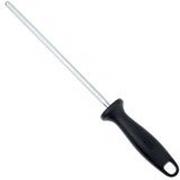

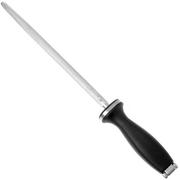


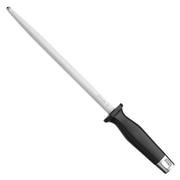

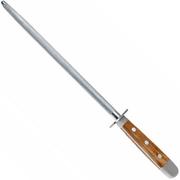

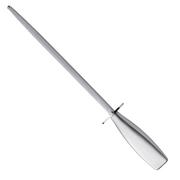

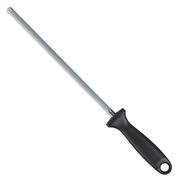

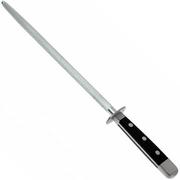


Honing steels work best on knives made from soft steel types. In any case, the honing steel must be harder than the knife. A honing steel should not be confused with a sharpening steel. Sharpening steels are designed to remove steel because they are made of a grinding material.
Every knife becomes duller the more it is used for cutting. Very small burrs appear on the cutting edge of the knife. You cannot see these burrs yourself, so we are not talking about ‘bites’ from the cut. A honing steel folds back these small burrs. This will straighten the blade, sharpen the knife and make cutting easier.
The larger your knife, the better it is if your honing steel is longer. That is why different sizes of honing steels are available. However, if your knife is really blunt, using a honing steel is no longer effective. In that case, you should use a whetstone or sharpening steel.
You can hold a honing steel in your hand and run the knife, which you hold in your other hand, along it. However, for greater stability, we recommend placing the honing steel vertically on a chopping board with the tip pointing downwards. Hold the handle at the top. Next, take the knife in your other hand and place the tip against the top of the honing steel (near the handle). When you hold it in your hand, the cutting edge is usually facing you; when you put the honing steel in place, the cutting edge is facing away from you. Always maintain an angle of 20 degrees for European knives and a smaller angle (up to 15 degrees) for Asian knives. Now move the knife away from you while pulling the blade across the honing steel (at the same angle). Repeat this at the bottom of the honing steel to do the other side. Read more about its use on our information page about honing steels.
If you use your knives intensively, you can regularly sharpen them with a honing steel. The result is that your honing steel will turn slightly dark in colour. You can clean this by rubbing a piece of paper with olive oil or sunflower oil along the honing steel. Honing steels also wear out, so they too need to be replaced over time.
A term you often come across is ‘whet steel’. But is that different from a honing steel? The short answer is no. A whet steel and a honing steel are the same thing. There is a difference between a honing steel and a sharpening steel. A sharpening steel is intended to sharpen your knives. There is no such thing as a diamond or ceramic honing steel. What does exist is a diamond-coated sharpening steel and a ceramic sharpening steel.
A Zwilling honing steel is indispensable for anyone who wants to keep their kitchen knives sharp. By running your knife along it a few times before cutting, you can easily straighten out any burrs that occur during use. Important to know: a honing steel does not sharpen or remove material, but it does ensure that your knives retain their optimal cutting ability. This will reduce the number of times you need to sharpen your knives and significantly extend their lifespan. With an ergonomic handle, the honing steel lies securely and comfortably in the hand during use.


